 DevHeist
SISTEM +
The shop floor answers its own questions — where an order is, why a machine is standing, and how much material a job really used.
A joinery production floor where every work order, machine, stoppage and sheet of board records itself while the work is being done.
What we delivered
- The complete production system, end to end
- Interfaces for management, technical staff, machine terminals and hall screens
- Built for Stolarkomerc and running in its production halls
Scope
Built for
- Production management
- Technical staff and drawings
- Machine operators on the floor
- Finishing and dispatch
01 Overview
SISTEM + follows a work order from the drawing to the loading bay — through every machine it passes, everyone who worked on it, every stoppage and every sheet of board it consumed.
Before it, production ran on paper and on asking. Where is order 127 — someone walks to the hall. Why has that machine been standing for two hours — nobody wrote it down. How much board went to waste — there was no such number.
Now the answer writes itself while the work is done. An operator presses start and finish; the report is a by-product of the job rather than an extra task.
02 The challenge
Nothing on the floor was recorded as it happened, so every question about it had to be answered by interrupting someone.
- 01 Work orders located by walking into the hall and asking
- 02 Machine downtime with no recorded reason
- 03 Output per person estimated rather than measured
- 04 Material use and waste never quantified
- 05 Delays discovered when the customer called
03 The solution
An interface built for each place it is used — office, drawing desk, machine and hall — and one record underneath all of them.
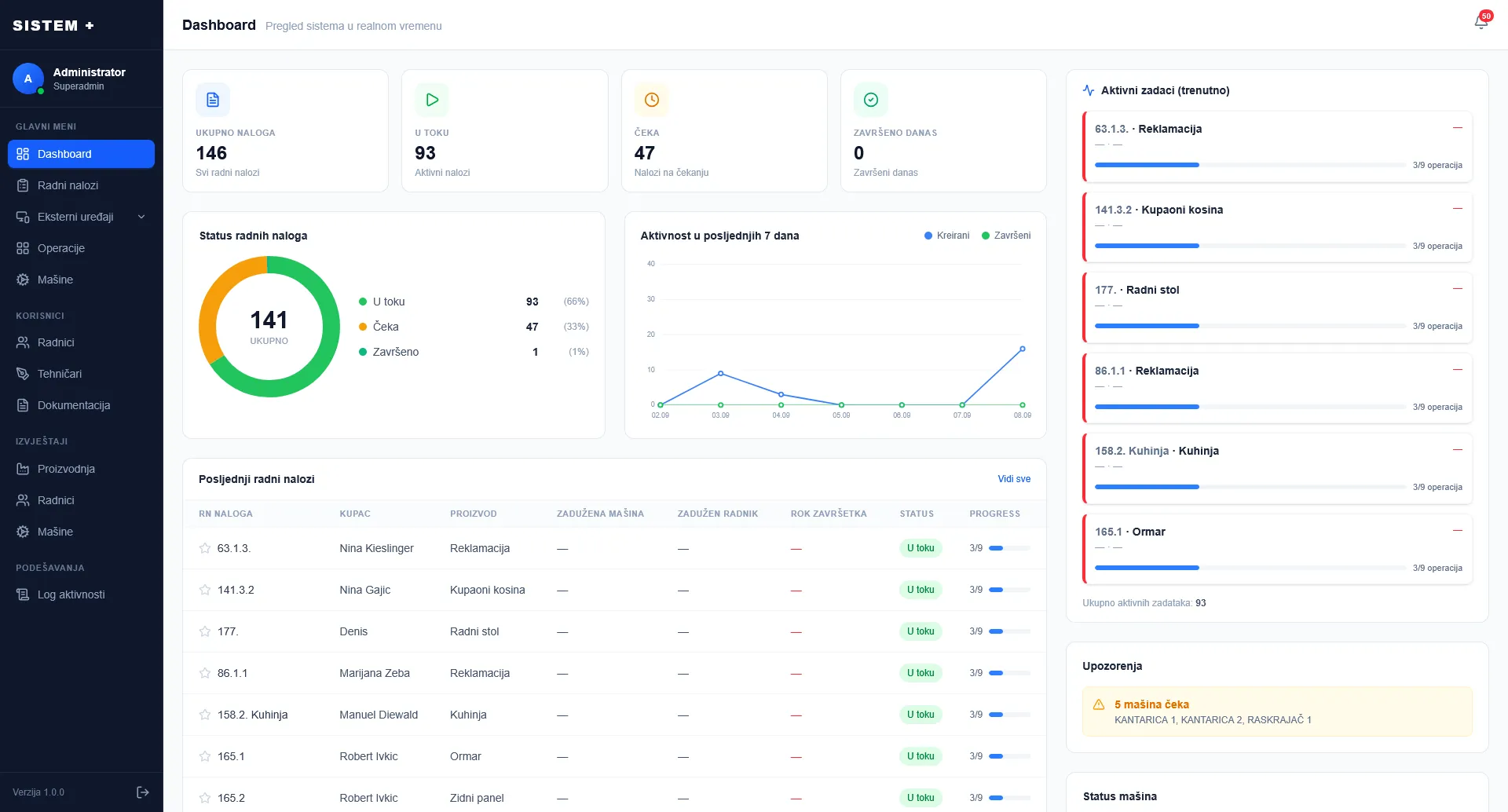
A work order is created with its customer, quantity, priority and deadline. The system builds the chain of operations and sends each one to the machine with the shortest queue.
The operator's terminal shows what is next and opens the drawing on screen: start, pause, finish, or report a stoppage with its reason — one press each.
Screens in the halls show the live state of every order, and the finishing tablet lists exactly what needs doing now — an order appears there only once the machine work is complete.
04 Key capabilities
What it makes possible.
- 01
Live status on the hall wall
Screens in each hall show every order, the operation it is on, who is working it, what is waiting and what is running late — updating as it happens and readable from across the floor.
- 02
A terminal built for the floor, not the office
Large buttons, no menus and the drawing on screen. It is used in gloves, at arm's length, by people who should not have to read carefully to use it.
- 03
Stoppages that become a number
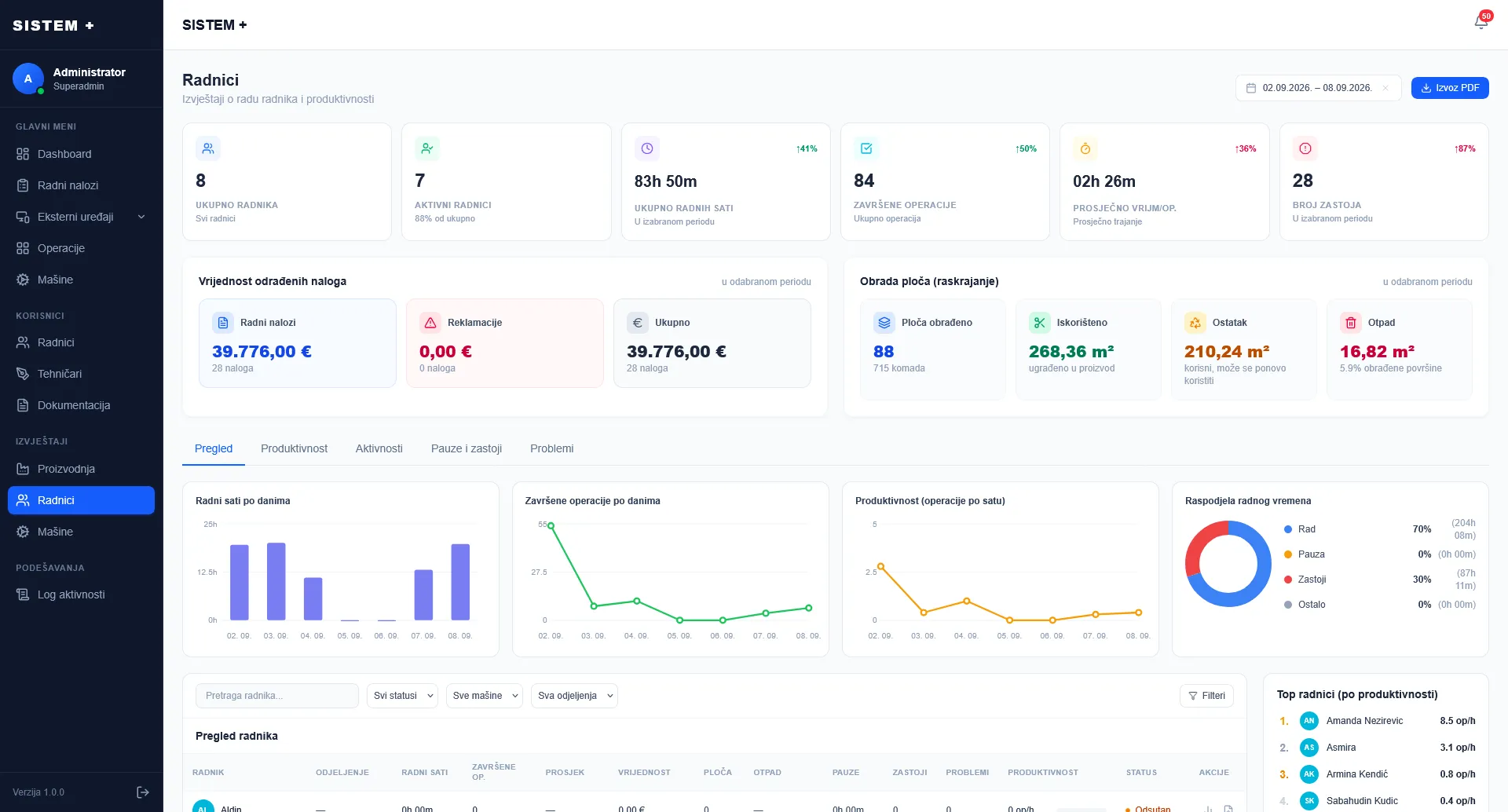
A stoppage is reported in one press with its reason — breakdown, missing material, waiting on a drawing, maintenance — and timed automatically. Lost time stops being an impression and becomes something that can be reduced.
- 04
Material use recorded without being entered
When a cutting plan is attached, the system reads its material summary — sheets, pieces, usable offcut and waste. When the operator finishes cutting, that consumption is credited to the job and to the person, with no extra step.
- 05
Drawings that cannot go missing
Each order carries its own documentation with every version kept, and the approved drawing appears at the machine that needs it.
- 06
Output measured, not estimated
Operations completed, time spent, material and waste, order value and downtime by reason — per person, per machine and over any period, compared with the period before it.
05 Business value
What changes for the business.
-
The state of the floor is visible without leaving the office or interrupting anyone.
-
Lost time has a reason attached to it — the first step to reducing it.
-
Rework is tracked apart from regular orders, because it is a cost rather than income.
Production that records itself as it runs, and can account for every hour and every sheet.